





The changes this year are summarised here. The following list focuses on the changed values and guidelines in Payroll 2026 that will apply from 1 January 2026. Any deviating dates of entry into force are specifically noted.
A
Registration for social insurance
From 2026, the social security registration must include the „extent of the agreed working hours“ as additional information. For example, for 38.5 hours per week, „3850“ is to be entered. For casually employed persons, the planned daily working hours must be stated instead of the weekly working hours.
However, changes to working hours during an ongoing employment relationship do not have to be reported. It is mandatory for employees, workers and apprentices to report the agreed working hours, but not for freelancers.
Unemployment insurance - low pay (marginal amounts)
| Monthly contribution base | Employee / Labourer | Apprentice |
|---|---|---|
| up to EUR 2,225.00 | 0 % (-2,95 %) | 0 % (-1,15 %) |
| from EUR 2,225.01 to EUR 2,427.00 | 1 % (-1,95 %) | 1 % (-0,15 %) |
| from EUR 2,427.01 to EUR 2,630.00 | 2 % (-0,95 %) | 1.15 % (normal set) |
| over EUR 2,630.00 | 2.95 % (normal set) | 1.15 % (normal set) |
Unemployment insurance obligation and marginal multiple employment
From 1 January 2026, marginal employment is only subject to unemployment insurance if it leads to the marginal earnings threshold being exceeded together with another marginal employment. If marginal employment is carried out alongside fully insured employment (which is subject to unemployment insurance anyway), this marginal employment is no longer subject to unemployment insurance and does not increase the assessment basis for unemployment insurance.
It remains unchanged that the consideration of several marginal jobs in the area of health and pension insurance is independent of this and continues to apply. If the jobs exceed the marginal earnings threshold in total, they must be taken into account as before.
See also our blog article on this topic.
Partial retirement reform
A. Changes for continuous partial retirement programmes (ATZ) starting from 2026
1 | Reduction of the maximum runtime
The „eligible“ duration of continuous part-time retirement is being gradually reduced to three years between 2026 and 2028 (previously: five).
Transition phase
- Start of ATZ 2026: The maximum duration of „subsidised“ ATZ is 4.5 years.
- Start of ATZ 2027: The maximum duration of „subsidised“ ATZ is 4 years.
- Start of ATZ 2028: The maximum duration of „subsidised“ ATZ is 3.5 years.
Permanent right
Start of part-time retirement (ATZ) from 2029: The maximum duration of „subsidised“ ATZ is three years, specifically in the last three years before the corridor pension reference date or the attainment of the statutory retirement age. Upon reaching the corridor pension reference date, part-time retirement is therefore no longer „eligible for subsidy“.
During the transition phase (phased retirement starting from 2026 to 2028), the earliest possible start of phased retirement remains possible five years before the statutory pension age, but there is a risk of funding gaps if no early pension entitlement exists at the end of the phased retirement. During the transition phase, meeting the requirements for a corridor pension (without actually drawing it) is not an obstacle to „subsidised“ phased retirement.
2 | Number of years of unemployment insurance required increased
The required periods of employment subject to unemployment insurance contributions will be gradually increased from the current 780 weeks (= 15 years) to 884 weeks (= 17 years) for continuous partial retirement schemes starting from 2026. 884 weeks are required in the case of partial retirement starting from 1 January 2029.
3 | New calculation mode for the „superior calorific value“
For continuous partial retirement with a start date from 2026, the following applies: The upper value for determining the wage equalisation is calculated exclusively from the remuneration for normal working hours.
This means that overtime, overtime flat rates and KV overtime are not to be taken into account; according to the AMS, these must also be calculated from an all-in salary. Remuneration for TC overtime (probably only basic overtime wages without the 25 % bonuses) should, however, be included for reasons of EU law, but official statements from the AMS or the Ministry of Social Affairs are not yet available.
4 | Adjustment of the AMS replacement rate
The previous replacement rate of 100 % from reaching the corridor pension requirements no longer applies. For continuous ATZ starting from 2026 to 2028, the replacement rate in these years is 80 %. From 2029, it will increase again to 90 %.
B. Prohibition of secondary employment
This prohibition applies to all Phased retirement. From 2026, further employment during phased retirement with other employers (standard or free service contracts, marginal as well as fully insured) will only be permitted if it already existed regularly in the year prior to the start of phased retirement. According to the AMS interpretation, „regularly“ means at least 28 days of employment in the year prior to the start of phased retirement (also in the case of seasonal employment). If this requirement is not met, the employer loses entitlement to phased retirement benefit, and the wage compensation and the increased social security contribution base will also cease to apply. Employees must report any additional activity to the AMS without delay. Self-employed activities do not fall under the ban on secondary employment during phased retirement. Employment law requirements, such as the non-compete clause, remain unaffected.
As a transitional regulation, existing inadmissible secondary employment - i.e. activities that were not already regularly performed in the year prior to the start of the partial retirement scheme - must be terminated by 30 June 2026 in order to avoid the loss of the subsidy.
Revaluation figure
The relevant revaluation figure for the revaluation of contribution-related social insurance values, which is used, for example, for the maximum contribution base, threshold values for unemployment insurance low pay, e-card service fee, etc., is 1.073 for the calendar year. Due to a special legal regulation, the low income threshold remains exempt from revaluation in 2026.
B
Disability compensation tax
The monthly compensatory tax per vacant mandatory position in 2026 is:
| for employers with 25 to 99 employees | EUR 344.00 |
| for employers with 100 to 399 employees | EUR 485.00 |
| for employers with 400 or more employees | EUR 512.00 |
The equalisation tax for 2026 will be imposed in 2027 by notice from the Social Ministry Service.
Educational leave and part-time education NEW
An amendment to the AMSG and AVRAG provides for new framework conditions for educational leave and part-time educational leave. The continuing education allowance or continuing education part-time allowance is intended as a replacement or successor to the former continuing education allowance or continuing education part-time allowance. There is no legal entitlement to the allowance.
Even if the amendment to the law comes into force on 1 January 2026, the AMS federal guideline relevant to the promotion of educational leave and part-time education will not come into force until 1 May 2026 at the earliest, depending on the technical implementation. According to AMS information, it will probably not be possible to apply for the subsidy and the earliest possible start of training and further education until 8 June 2026.
Legal framework conditions:
- The requirement for uninterrupted employment as a prerequisite is increased from six to 12 months in the current employment relationship.
- Funding focus | Lower-qualified employees benefit first and foremost. Academics must fulfil stricter conditions, namely a total of at least four years of employment covered by unemployment insurance, of which the last 12 months must be in the current employment relationship.
- Employer cost sharing for higher earners | From half of the ASVG maximum contribution base, 15 % of the total subsidy must be co-financed by the employer as a direct subsidy to the employee (further training subsidy); the AMS subsidy is reduced accordingly. The company training allowance is exempt from wage tax and is exempt from contributions to the company pension scheme and social insurance (social security contributions are paid by the AMS). In the area of DB, DZ, KommSt, the subsidy is subject to tax; it is currently unclear whether there will be an amendment to the law in this regard.
- Content of the labour law agreement | The employee's level of education, the type and duration of the training programme, the training objective and - in the case of part-time training - the extent and location of the reduced working hours must be recorded.
- „parental leave ban“ | It is no longer possible to connect the period of further training directly to the receipt of weekly allowance or childcare allowance, as this must be immediately preceded by at least 26 weeks of employment covered by unemployment insurance.
- Aid amount | Only minimum and maximum amounts are specified by law (2026: EUR 41.49 to EUR 69.77 per day). The exact criteria are set out in an AMS guideline.
- Part-time employment during the (partial) training period | Only permissible if it is with an employer other than the employer taking the leave and has already existed for at least 26 weeks before the start of the training programme.
D
Employer dashboard
The new ÖGK employer dashboard (DG dashboard) was launched on 1 October 2025. All information and services are bundled on one user-friendly platform. The following applications are currently available there Contribution account, contractor account, applications (e.g. clearance certificate), mailbox, clearing, international, news, search/help. The DG dashboard is to be continuously developed and further functions added.
Link to the employer dashboard
Employer surcharge (DZ)
The employer surcharge (DZ) or „Chamber Surcharge 2“ will decrease by 0.01 percentage points in Salzburg and Lower Austria in 2026. In all other federal states, the DZ will remain the same as in 2025. An overview of the DZ for 2026:
| Salzburg | 0,35 % | Carinthia | 0,37 % | LOWER AUSTRIA | 0,33 % |
| UPPER AUSTRIA | 0,31 % | Burgenland | 0,40 % | Styria | 0,34 % |
| Tyrol | 0,39 % | Vorarlberg | 0,33 % | Vienna | 0,36 % |
Official flat m² guide values
The square metre guideline values for residential property valuation will remain unchanged in 2026:
| Salzburg | EUR 9,22 | Carinthia | EUR 7,81 | LOWER AUSTRIA | EUR 6,85 |
| UPPER AUSTRIA | EUR 7,23 | Burgenland | EUR 6,09 | Styria | EUR 9,21 |
| Tyrol | EUR 8,14 | Vorarlberg | EUR 10,25 | Vienna | EUR 6,67 |
E
E-Card service fee
Collection in November 2026 in advance for 2027: EUR 26.85.
Pensioners must also pay the service fee from 2026. The pension insurance institution will collect the fee for the first time on 15 November 2026 for the 2027 calendar year.
Electric vehicles („charging at home“)
Pursuant to Section 4c of the Non-Monetary Remuneration Values Ordinance, the following applies: If the employer reimburses or bears the costs for charging a company electric car at a charging facility belonging to the employee, this is tax-free up to the amount of the official electricity price. The prerequisite for this is the demonstrable allocation of the amount of electricity charged to the electric vehicle.
The applicable rate in 2026 is 32.806 cent/kWh (2025: 35.889 cent/kWh).
The alternative of a tax-free monthly flat-rate reimbursement of EUR 30.00 for the calendar years 2023 to 2025 expired on 31 December 2025. This option was intended for cases where the charging quantity could not be technically allocated to the employer's own electric vehicle. From 2026, only the official electricity price variant, which requires the charging quantity to be technically attributable to the employer's own electric vehicle, will therefore be possible for the exemption from charges.
Minimum subsistence level
| Wage garnishment values in 2026 | monthly | weekly | daily |
|---|---|---|---|
| General basic amount | EUR 1,308.00 | EUR 305.00 | EUR 43,00 |
| Increased general basic amount | EUR 1,526.00 | EUR 356.00 | EUR 50,00 |
| Basic maintenance amount (max. 5 times) | EUR 261.00 | EUR 61,00 | EUR 8,00 |
| Maximum calculation basis | EUR 5,220.00 | EUR 1,220.00 | EUR 174.00 |
| Absolute minimum subsistence level | |||
| > with normal execution | EUR 654.00 | EUR 152.50 | EUR 21,50 |
| > in the case of maintenance execution | EUR 490.50 | EUR 114.38 | EUR 16,13 |
Link: Wage garnishment tables for 2026
F
Ordinance on the reimbursement of travelling expenses
From 1 January 2026, the option to pay out the so-called „public transport mileage allowance“ (Öffi-Kilometergeld)—a flat-rate transport subsidy for business trips—tax-free or to claim it as income-related expenses in the tax assessment will be abolished.
In future, the following will apply: If the actual travel costs are not reimbursed or taken into account (e.g. because the employee uses a privately purchased climate ticket), the travel costs regulation will only allow the use of fictitious travel costs for the cheapest means of mass transport as an alternative. The reimbursement of costs per calendar year is limited to the cost of the Climate Ticket Austria Classic (2026: EUR 1,400.00).
Holiday pay
Public holiday pay is tax-free again for periods from 2026 within the scope of the tax-free allowance. This means that the tax liability for public holiday pay, which was retroactively applicable from 1 January 2025 as a result of a BFG ruling, will be eliminated with effect from 1 January 2026.
Freelance employment
An amendment to the law provides for two changes to labour law for freelance employment relationships from 2026:
- Explicit statutory cancellation regulation for freelance employment relationships | Either party to the contract may terminate the freelance employment relationship subject to a minimum notice period. The notice periods and deadlines must be observed: 4 weeks, after 2 years of service 6 weeks, in each case on the 15th or last day of the calendar month. This applies to all new freelance employment relationships in 2026. For existing freelance employment relationships, the new rule only applies if no notice period has been agreed. As a protective clause, it is stipulated that an individual contractual cancellation or restriction to the detriment of the freelancer is excluded.
- Inclusion in collective agreements | From 2026, freelance employees (compulsorily insured in accordance with Section 4 (4) ASVG, fully insured or marginally insured) can be included in the scope of collective agreements (often referred to as the „Lex Lieferando“). This means that the parties to the collective labour agreement can (also) set minimum wages and other regulations for freelance employment relationships. This is implemented either through separate collective agreements for freelance employees or through explicit inclusion in existing collective agreements.
Please note: The personal scope of application of existing collective labour agreements will not automatically be extended to include freelance employees in 2026. These are only subject to the relevant collective agreement if the relevant parties to the collective agreement agree to amend the collective agreement and expressly include freelance employment relationships in its scope of application.
G
Marginal employment alongside unemployment
The possibility of marginal employment while receiving unemployment benefit or unemployment assistance will be abolished in principle from 2026. It will only be permitted in five exceptional cases without losing unemployment benefit or unemployment assistance.
Temporary exception
- Already in marginal employment for at least 26 weeks before becoming unemployed
- Long-term unemployed (unemployed for at least 52 weeks, interruptions of up to 62 days are harmless) with a favoured disability status or disability pass
Temporary exception
- Long-term unemployed (unemployment for at least 52 weeks, interruptions of up to 62 days are irrelevant) without the above-mentioned proof of disability
- Certain long-term sick persons (at least 52 weeks)
- Persons who complete a specific retraining or further training programme on behalf of the AMS
Further details are regulated in § 12 para. 2 AlVG.
Important: The elimination of the marginal additional earnings option (including the five exceptions) not only affects new hires after 1 January 2026, but also existing marginal employment. Due to the statutory transitional period (one-month tolerance period), these must be terminated by 31 January 2026 at the latest - otherwise the unemployed person risks losing their unemployment benefit or unemployment assistance (§ 81 para. 20 AlVG).
It is the responsibility of the unemployed person to ensure that the marginal employment is terminated in good time (e.g. by giving notice or by mutual agreement). From a business perspective, it is nevertheless advisable to actively inform marginally employed persons who joined the company before 1 January 2026 of the new regulation in order to avoid unpleasant surprises.
Minority threshold
The low income threshold for 2026 remains at the value for 2025 (as does the threshold derived from this for the flat-rate employer contribution).
| Monthly low income threshold | EUR 551.10 |
| Daily insignificance limit | no longer applicable (since 01.01.2017) |
| Limit for flat-rate DG levy (19.4 %) | EUR 826.65 |
| Self-insurance (§ 19a ASVG) monthly | EUR 83,49 |
H
Maximum contribution base
Maximum contribution base 2026
| daily | EUR 231.00 |
| monthly | EUR 6,930.00 (for freelance employees without SZ: EUR 8,085.00) |
| Special payments (annual) | EUR 13,860.00 |
I
Inflation adjustment of tax values
The Inflation Adjustment Ordinance 2026 provides for the following: From 1 January 2026, the income tax brackets and various tax-relevant amounts (e.g. AVAB/AEAB, transport deduction) will be adjusted by 2/3 of the inflation rate. Based on the calculated inflation rate of 2.6 %, this results in an increase of 1.733 % (rounded up to full euros). As a special regulation, the utilisation of the remaining third of the inflation rate for 2025 to 2028 is suspended.
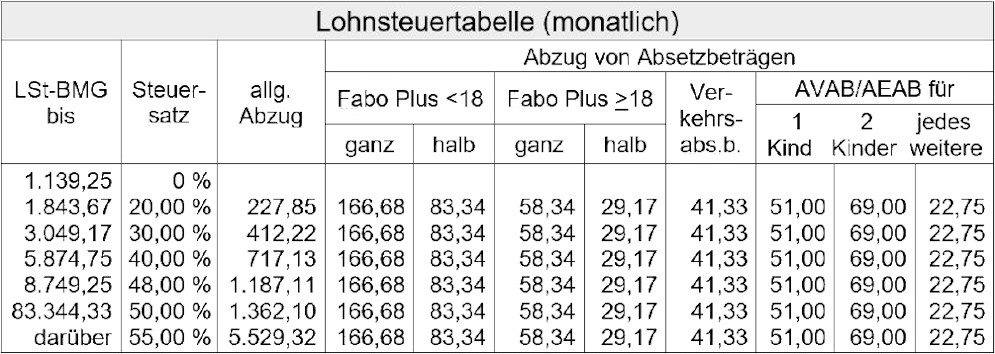
The income tax brackets adjusted for inflation for 2026 as well as the values for the single earner/single parent tax credit (AVAB/AEAB) and the commuter tax credit are taken into account in the effective income tax table – see keyword „Income tax table for 2026„.
K
Kilometre allowance
On 1 July 2025, the tax-free mileage allowance rates for motorbikes and bicycles were reduced from EUR 0.50 to EUR 0.25. The tax-free mileage allowance for cars (since 1 January 2025: EUR 0.50) remained unchanged.
The following list now shows the regulations applicable as at 01.01.2026 tax-free maximum amounts:
| Kilometre allowance car | EUR 0,50 |
| Mileage allowance for motorbikes | EUR 0.25 |
| Kilometre allowance for passengers | EUR 0.15 |
| Kilometre allowance bicycle | EUR 0.25 |
| Kilometre allowance for pedestrians | EUR 0.38 for > 1 km |
Non-competition clause Charge limit
The following monthly salary limits apply in 2026 for the possible application of a non-competition clause upon termination of the employment relationship:
| Non-competition clause agreement concluded | Charge limits |
|---|---|
| from 29.12.2015 | EUR 4,620.00 (excl. pro rata rent) |
| between 17.03.2006 and 28.12.2015 | EUR 3,927.00 (incl. pro rata SZ) |
| until 16 March 2006 | No fee limit |
Corridor pension
The minimum age for a corridor pension will be gradually raised from 62 to 63 from 1 January 2026. There will also be a gradual increase in the number of pension insurance months required for this from 480 (= 40 years) to 504 (= 42 years), depending on the date of birth:
| Minimum entry age | required PV months | |
|---|---|---|
| born until 31.12.1963 | 62 years | 480 |
| 01.01.1964 until 31.03.1964 | 62 years and 2 months | 482 |
| 01.04.1964 until 30.06.1964 | 62 years and 4 months | 484 |
| 01.07.1964 until 30.09.1964 | 62 years and 6 months | 486 |
| 01.10.1964 until 31.12.1964 | 62 years and 8 months | 488 |
| 01.01.1965 until 31.03.1965 | 62 years and 10 months | 490 |
| 01.04.1965 until 30.06.1965 | 63 years | 492 |
| 01.07.1965 until 30.09.1965 | 63 years | 494 |
| 01.10.1965 until 31.12.1965 | 63 years | 496 |
| 01.01.1966 until 31.03.1966 | 63 years | 498 |
| 01.04.1966 until 30.06.1966 | 63 years | 500 |
| 01.07.1966 until 30.09.1966 | 63 years | 502 |
| 01.10.1966 until 31.12.1966 | 63 years | 504 |
Notice periods for employees
According to an amendment to the Austrian Civil Code (ABGB) that has already been passed, the statutory notice periods and notice periods for employees will be changed with retroactive effect from 1 July 2025:
- While a notice period of six weeks and its length-of-service-dependent increase to up to five months (with the termination date continuing to be the end of a calendar quarter, although an agreement on the 15th and/or the last day of the calendar month is also possible) remains unchanged, what is new, however, is that the statutory authorisation for collective bargaining partners to regulate notice periods derogating from this for predominantly seasonal industries (the „seasonal privilege“) is being removed from the law retroactively as of 01.07.2025.
- However, an exception provision (so-called “petrification“) ensures that those collective agreement special regulations that were previously explicitly based on the seasonal privilege remain in place: Deviating collective agreement notice period regulations remain valid if they were promulgated between 01.01.2018 and 30.06.2025.
- However, a minimum notice period of one week applies in any case, i.e. even if a „petrified“ collective agreement contains a shorter notice period.
List of the „petrified“ statutory health insurance funds
The explanatory notes to the amendment to the law list 29 collective agreements that fulfil the requirement for the continued application of deviating termination regulations:
- Collective agreement in the agricultural service industry,
- Collective agreement for the construction industry and building trade,
- Collective agreement for the building trade,
- Collective agreement for guards in the security industry,
- Collective agreement for the floor laying trade,
- Collective agreement for well drillers, foundation engineering and deep drilling contractors,
- Collective agreement for the roofing trade,
- Framework collective agreement for monument, façade and building cleaning, in other cleaning trades and in caretaking activities,
- Collective agreement for the iron and metalworking industry for the tinsmith and coppersmith trades,
- Collective agreement for commercial forestry companies,
- Collective agreement for the glazier trade,
- Collective agreement for commercial cemetery gardening companies,
- Framework collective agreement for commercial gardeners and landscapers,
- Collective agreement for the stove, tile and paver and ceramics trades,
- Collective agreement for the timber construction industry,
- Collective agreement for the painting, varnishing and sign-making trades,
- Collective agreement for the paving trade,
- Supplementary collective agreement to the collective agreement for the chimney sweep trade dated 1 January 1988,
- Framework collective agreement for pest control,
- Collective agreement for the stone working industry,
- Collective agreement for the upholstery trade,
- Collective agreement for the wood and plastics processing industry in the version applicable to carpenters and wood designers dated 1 May 2021,
- Collective agreement for private bus companies,
- Collective agreement for inland navigation,
- Collective agreement for Austrian cable cars,
- Collective agreement for the goods transport industry,
- Collective agreement for the small transport industry,
- Collective agreement for the stone and ceramics industry,
- Collective agreement for glass working and processing, flat glass grinding.
L
Income tax table for 2026
With effect from 1 January 2026, there will be new income tax tables, as the threshold amounts for the rate brackets and some tax deductions will be valorised. There are slight deviations from the provisional version published in 2025. Below you will find the monthly income tax table for employees for the 2026 calendar year:
Pay slip L16
The L16 version for the 2026 calendar year will be extended by several new fields compared to the 2025 version:
- These items included in the gross remuneration (KZ 210) are to be broken down individually by amount: remuneration in kind for motor vehicles, remuneration in kind for housing, other remuneration in kind.
- Remuneration included in the tax-free remuneration (KZ 215) must be stated separately.
- In the „Other deductions“ column, the amounts of the following tax-free benefits must be stated separately: Contributions to future security, employee share ownership, employee share ownership foundation, car sharing subsidies, meal vouchers, employee discounts.
- The following parameters must be entered for the calculation of non-cash benefits for motor vehicles: Tick the percentage rate 0 %, 1.5 %, 2 % or the average percentage rate for pool vehicles; acquisition cost of the vehicle as at 31 December.
- Separate disclosure of „Charging costs for electric vehicles“ and „Acquisition of charging equipment“ (previously together).
M
Employee bonuses
It remains to be seen whether the option of a tax-free employee bonus will be available again in 2026. The Federal Ministry of Finance has the legal mandate to evaluate the budgetary effects and the effectiveness of the wage tax exemption in connection with the employee bonus by 30 April 2026 and, based on this, to draw up a legislative proposal for a possible employee bonus in 2026 by 31 May 2026.
Employee discounts
Contrary to the long-standing legal view of the Federal Ministry of Finance (BMF), the Administrative Court (VwGH) has ruled that the tax concessions relating to staff discounts (the 20 % exemption limit and the EUR 1,000.00 annual allowance) are not restricted to „active“ employees, but are also available to former employees (e.g. company pensioners). The provisions in the Payroll Tax Guidelines must therefore be amended by the Federal Ministry of Finance.
P
Commuter Euro
The commuter euro, which is due in addition to a commuter allowance, will be increased from EUR 2.00 to EUR 6.00 per year (per kilometre of the one-way journey from home to work) from 1 January 2026. The tripling of the amount is intended by politicians as partial compensation for the abolition of the climate bonus.
Pension settlement
The threshold amount for preferential taxation of pension settlements (half tax rate) will increase from EUR 15,900.00 to EUR 16,500.00 in 2026.
Nursing professions
From 2026, nursing professions (nursing assistants, specialist nursing assistants, senior healthcare and nursing staff) will be recognised as heavy work regardless of any special treatment or care requirements. In the case of shift work, every calendar month with at least 12 working days counts as a month of heavy labour, in deviation from the general principle according to which 15 working days are otherwise required.
R
Retroactive KV contracts
Contrary to a long-standing practice, the Supreme Court ruled that retroactively concluded collective labour agreement regulations (e.g. wage and salary increases, retrospective bonuses, etc.) also apply to employees who have left the company in the meantime. This means that the parties to the collective agreement are authorised to create retroactive entitlements for employment relationships, regardless of whether the employment relationships are still valid at the time the collective agreement is concluded or not. In this context, subsequent payments to employees who have already left the company must generally be implemented in payroll accounting with a roll-up.
S
Athlete compensation
From January 2026, it will be possible to claim both the lump-sum volunteer allowance for voluntary work and a lump-sum athletes' expense allowance tax-free within the same calendar year - but not in the same calendar month. The volunteer lump sum (small or large) cannot be claimed additionally in months with a sportsperson's expense allowance; it only applies in the other months.
The annual amount of the volunteer allowance must be reduced on a pro rata basis for months with athlete expense allowances. This is relevant, for example, for athletes who volunteer for another function in the same club during the summer break.
T
Partial pension
Insured persons who fulfil the requirements for an old-age pension, long-term insured person's pension, corridor pension or heavy labour pension can draw a partial pension. From 2026, this will be possible in parallel with continued part-time employment to a percentage of the full pension. This is a combination of reduced-working-time employment and partial pension payment from the pension insurance institution.
The pension account is closed to the extent of the percentage of the partial pension. The remaining part remains open, continues to grow through the pension insurance contributions from the part-time employment relationship and increases the later full pension accordingly. An agreement between the employee and employer is required (there is no legal entitlement). This agreement must provide for a reduction in the previous working hours of at least 25 % and a maximum of 75 %. The extent of the reduction is determined by the normal working hours predominantly worked in the 12 months prior to the reference date; the extent of the partial pension is determined directly by the agreed extent of the reduction in working hours.
| Extent of the reduction in working hours | Extent of the partial pension |
|---|---|
| by 25 % to 40 % | 25 % of the current pension account credit |
| by 40.01 % to 60 % | 50 % of the current pension account credit |
| by 60.01 % to 75 % | 75 % of the current pension account credit |
Partial retirement is currently unproblematic for payroll accounting: in the case of partial retirement, no fictitious SI or BV contribution bases are to be applied, there is neither wage equalisation nor reimbursement of wage costs by official bodies. Partial retirement is therefore to be treated for the most part like regular part-time work (e.g. holiday compensation is only due on the basis of part-time pay). However, there are special protective provisions for old severance pay, which is calculated on the basis of the previous normal working hours.
As the various options are complex in terms of financial outcomes and a comprehensive assessment of the situation is necessary, employees should be referred to the relevant advice centres, such as the PVA, when enquiring about pension advice. Information on this can be found on the PVA website.
Flat-rate tipping - contribution law
The legal framework for tips will be adapted in several respects with effect from 2026:
- No SI obligation for tips above the fixed lump sums | The law makes it clear that the fixed lump sums are maximum amounts. The tips actually received can only be taken into account if they are lower. The actual tip amount will therefore no longer be used for the SI contribution base from 2026, even if it is demonstrably higher.
- Retrospective clarification / “amnesty“ | The right of the social insurance institution to set contributions for tips in excess of the flat rate expires in 2026. The prerequisite for this is that the insurance institution announces new flat-rate tips based on the new legal situation by 30 September 2026. If advance notices or subsequent charges have already been issued, possible cases of hardship with regard to subsequently charged tip-related contributions must be examined by the social insurance institution (usually ÖGK) within the framework of self-administration; in this case, however, the contribution bases of the insured persons remain unaffected.
- Information and disclosure obligations of the company | All employees who participate in a tip distribution system must be informed about the distribution key at the beginning of the employment relationship; in the case of existing employment relationships, the information must be provided by 28 February 2026 at the latest. Employees who receive tips or share in the tips have a right to information about the amount of non-cash tips given.
Flat-rate tips in the hotel and catering industry
On the basis of an agreement between the social partners, the ÖGK will set standardised flat-rate tip rates subject to social insurance contributions throughout Austria in the hotel and catering industry from 1 January 2026. The flat-rate tip rates apply to employees, including apprentices/mandatory interns, who are employed in member companies of the WKO trade associations for the hotel and catering industry. In the case of mixed businesses, the decisive factor is whether the employment relationship in question is subject to the collective agreement for the hotel and catering industry.
Apart from voluntary tips from third parties, those that are distributed within the establishment via a pooling system („Tronc system“) are also included.
The following are excluded from this flat-rate regulation:
- Employees in the catering industry,
- Employees in student, apprentice, student and retirement homes,
- Back-office employees (e.g. accountants, payroll accountants) and in-house technicians if they demonstrably do not receive tips (e.g. contractual prohibition on accepting tips, declaration of non-receipt of tips, etc.).
- Employees for whom the tips actually received in the contribution period are demonstrably less than 50 % of the respective flat-rate tip amount (in this case, the actual tips are decisive instead of the flat-rate tip amount).
The flat rate for tips is for the calendar month (standardised to 30 days):
| 2026 | 2027 | 2028 | |
|---|---|---|---|
| Employees with debt collection | EUR 65,00 | EUR 85,00 | EUR 100.00 |
| Employees without debt collection | EUR 45,00 | EUR 45,00 | EUR 50,00 |
| Apprentices and mandatory interns | EUR 20,00 | EUR 20,00 | EUR 25,00 |
From 2029, valorisation will take place annually with the revaluation figure.
For part-time and occasional employees, the aliquot partial amount of the tip allowance is to be applied. Examples (values for 2026):
> Waiter with collection, 25 hours per week: EUR 65.00 / 173 * 25 * 4.33 = EUR 40.67 per month
> Waiter employed on a case-by-case basis without collection: EUR 45.00 / 30 = EUR 1.50 per day
For periods of absence (e.g. holidays, sick leave or vocational school) that do not exceed one month in total, flat-rate tips are also to be applied; the flat rate is therefore only waived for continuous absences of more than one month (i.e. from the second month).
Tips - tax exemption
The explanations on the tax exemption of tips in the wage tax guidelines (LStR) were supplemented by the BMF in two points:
- Margin note 92d LStR: When checking whether tips are customary locally, the relation of the amount of the tip to the wage of the individual employee is not decisive.
- Marginal number 92f LStR: Tips that are collected through a tip distribution system (e.g. Tronc system) and distributed to employees according to a predetermined key (agreed verbally or in writing) are also covered by the tax exemption.
Ü
Overtime bonuses in accordance with § 68 EStG
Legal regulation for 2026
The special regulation applicable in 2024/25 (tax exemption for max. 18 overtime bonuses and max. EUR 200.00 per month) expires at the end of 2025. The EStG amendment of February 2026 (retroactive to 1 January 2026) again provides for a special regulation for the 2026 calendar year that is limited until the end of 2026: Tax-free overtime bonuses are possible for up to 15 hours of overtime per month and a maximum of EUR 170.00.
Overview of the tax-free maximum limits pursuant to Section 68 (2) EStG:
| max. number (monthly) | Maximum amount (monthly) | |
|---|---|---|
| until 2023 | 10 hrs. | EUR 86,00 |
| 2024 and 2025 | 18 hrs. | EUR 200,00 |
| 2026 | 15 hrs. | EUR 170,00 |
| from 2027 | 10 hrs. | EUR 120,00 (subject to future amendments to the law) |
Tightening of official enforcement practices
Wage audits are increasingly being discussed due to changes in the interpretation of the law.
- Working time calculation or flexitime with a period of several months | As long as the calculation or flexitime period is running, time account plus hours do not yet count as overtime. The tax concession pursuant to § 68 para. 2 EStG can therefore only be applied in those months in which the calculation or flexitime period ends (e.g. in the case of a six-month flexitime period, only twice a year). Tax relief may not be obtained by rolling up the payroll periods within the period. Even in the case of a flat-rate overtime allowance, it is not permitted to recognise the overtime that only arises at the end of the period as tax-privileged on a monthly basis in advance.
- All-in without working time calculation / flexitime | According to the new opinion of the Federal Ministry of Finance, the deduction of tax-free overtime bonuses pursuant to Section 68 para. 2 EStG from an all-in salary will only be recognised if either the maximum monthly number of relevant overtime hours (2025: 18, 2026: 15) or the maximum monthly amount (2025: EUR 200.00 or 2026: EUR 170.00) is reached on an annual average.
- All-in combined with several months of working time calculation/ flexitime | According to the new opinion of the Federal Ministry of Finance, this combination means that the deduction of tax-free overtime bonuses is not permitted at all. This is justified, among other things, by the fact that no (average) overtime is incurred during the current calculation or flexitime period.
- Stricter requirements for working time records | With reference to the decision of the VwGH, GPLB auditors are increasingly demanding perfectly prepared working time records for the tax exemption of overtime bonuses, in which the specific daily and temporal position of the favoured overtime and its explicit marking are clearly visible.
Each company must decide whether it wants to accept the risk of future tax back payments in the above-mentioned constellations or whether it would prefer to switch to taxable accounting in advance.
V
Interest on arrears in the SI
From 1 January 2026, the interest rate for default interest on overdue SI contributions will be reduced from 7.03 % to 5.53 %.
W
Housing subsidy contribution Vienna
Since 2018, the Housing Subsidy Contribution Act (Wohnbauförderungsbeitragsgesetz) has provided for the possibility for each federal province to determine the amount of the housing subsidy contribution independently. Until now, the federal states have not made use of this option. This has now changed for the first time: According to a resolution passed by the Vienna state parliament on 23 October 2025, the housing subsidy contribution in Vienna will be increased from 0.5 % to 0.75 % each for businesses and employees (i.e. from 1 % to 1.5 % in total).
Z
Interest savings (advance or employer loan)
For loans or advances for which a variable interest rate has been agreed, a percentage rate of 3.0 % applies in 2026 (2024/2025: 4.5 % in each case) according to the Federal Ministry of Finance.
For interest-free or fixed-interest loans or advances, the private housing interest rate published by the Austrian National Bank for the first time for the month of the loan or advance agreement (for fixed interest rates of more than ten years) minus 1/10 discount has applied since 1 January 2024. This „historical“ percentage rate must be applied consistently for the entire term of the loan or advance for which no interest or a fixed interest rate was agreed.
The OeNB interest rates are available here.
Status 26.02.2026
Created 22.12.2025
Source: Kraft & Kronberger specialised publications
Photo: Moore Salzburg